
Hair care: Oil or powder?
If your hair is dry or damaged, your shampoo and conditioner routine is not always enough to bring it back to its best. Sometimes you need an extra treatment: a mask, an oil bath…
Oil or powder for your hair? Both can help, as long as you choose well. Oils protect and coat the fibre when used in moderation, while Ayurvedic powders are used as masks to purify, strengthen or repair. Here is how to choose, the mistakes to avoid and a few simple recipes.
Is a hair oil bath good for your hair?
Hair oil baths are in fashion, and they are a natural treatment. But to make them work, you need to understand how hair works. Used the wrong way, oil can actually dry hair out or weigh it down.
We know many people who got the opposite of what they hoped for: dry, rough or dull hair, because oils were used the wrong way. Here are the right habits to avoid that.
Which oil should you choose for your hair?
First of all, choose your oil (or oils) according to how they act on the hair. There are two types:
- Penetrating oils: they can penetrate inside the hair.
- Non-penetrating oils, also called coating oils: they do not penetrate the hair, they stay on its surface and coat it.
This distinction matters, because you do not choose the same oil to smooth your hair as you do for an oil bath.
For an oil bath: penetrating oils
For oil baths, choose penetrating oils, for example coconut, olive, avocado, almond or castor oil. They are ideal before shampooing or before a swim, to protect the hair.
Hair is permeable: it absorbs water, which weakens it during washing. Penetrating oils strengthen the hair fibre and limit this water absorption.
To coat and smooth: non-penetrating oils
If you want to coat your hair and smooth the cuticles, opt for non-penetrating oils, such as jojoba oil or sunflower oil.
What mistakes should you avoid with oils?
- Leaving it on too long. Avoid keeping an oil bath on for several days, or even a week. Too much oil weighs hair down and smothers it. Instead of protecting it, a prolonged oil bath can dry it out.
- Using an oil every day. Applying a non-penetrating styling oil daily can also smother your hair, and dry out the part that gets oiled most often.
- Rinsing the oil out with several shampoos. Shampooing over and over to get rid of an oil bath can cancel out its protective effects. Choose an oil that penetrates the hair well, so you do not need to wash repeatedly.
- Putting oil on the roots. Oiling the scalp can smother and overload it, especially if it already produces a lot of sebum. The roots become very greasy, and dandruff can appear.
- Choosing the same oil as your friend. Every hair type reacts differently. Some oils do not suit fine, thick or afro hair. Try several oils to find the ones that work for you.
Remember this: oil can easily suffocate hair. It is not soluble in water, and its dense texture lets it protect the fibre, but overusing it smothers and dries the hair.
What are Ayurvedic powders for hair?
Ayurvedic powder masks are an alternative to oils, alongside your solid shampoo and conditioner routine. These powders, which come from Indian tradition, are made from dried plants, herbs, spices and plant materials.
They are credited with many benefits for hair: strengthening, hydrating, repairing, supporting growth, and fighting dandruff and excess sebum.
Which Ayurvedic powder suits your hair?
For oily hair
Purifying powders help fight greasy, weighed-down hair. A detox mask made with these powders leaves hair that gets greasy less quickly, and can reduce dandruff and itching.
- Rhassoul, nettle, neem.
For dry and damaged hair
If your hair is damaged, dull or lacks volume, other powders help bring back stronger, shinier hair.
- Aloe vera, baobab, hibiscus, fenugreek, kapoor kachli.
To support hair growth
- Amla, brahmi, orange.
Ayurvedic mask recipes to make at home
Mask to support hair growth
- 1 tablespoon of castor oil: it nourishes and repairs dry hair, and is known for encouraging growth.
- 1 tablespoon of mustard oil: traditionally used for hair growth and thickness.
- 2 tablespoons of organic amla powder: it tones and strengthens the hair.
- Optional: a few drops of grapefruit essential oil, known to tone and purify the scalp.
Apply this treatment to your scalp before shampooing. Leave it on for at least 10 minutes, or 1 hour if you have time, for a deep treatment. We recommend doing it twice a month.
Homemade anti-dandruff scrub
- 1 tablespoon of organic neem powder: detoxifying, cleansing and soothing.
- 1 tablespoon of cider vinegar: cleansing and sebum-regulating, it helps balance the pH of the scalp.
- 1 tablespoon of sugar: a gentle exfoliant that removes dead cells.
- Optional: tea tree essential oil, purifying, useful against oily dandruff.
Mix the neem powder with lukewarm water until you get a smooth, lump-free paste. Add the cider vinegar and sugar, then mix again. Apply the scrub to your scalp before shampooing and massage gently. Leave on for 10 to 15 minutes. You can do this once or twice a month.
Detox hair mask
- 1 tablespoon of organic neem powder: detoxifying, cleansing and soothing.
- 1 tablespoon of organic stinging nettle: remineralising and purifying.
- 1 teaspoon of organic marshmallow root: hydrating, detangling and softening.
- Optional: cider vinegar and tea tree essential oil.
Mix the powders with hot water until you get an even paste, lump-free if possible. Apply to your scalp before or after shampooing. Leave on for 10 to 30 minutes. You can use this mask once a week.
Please note: do not let the powders dry on your hair. Essential oils are powerful: use them in very small amounts, do a patch test on a small area of skin before the first application, and ask a health professional for advice if you are pregnant or have sensitive skin. If irritation occurs, rinse and stop.
Oil or powder: our view
Having tried both, we prefer Ayurvedic powders. We find them more effective and quick to act. But it all depends on your hair: try different formulas to find the one that suits you.
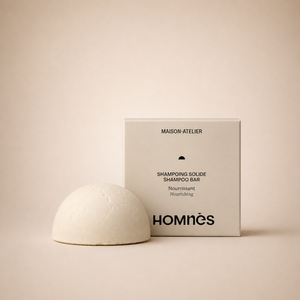
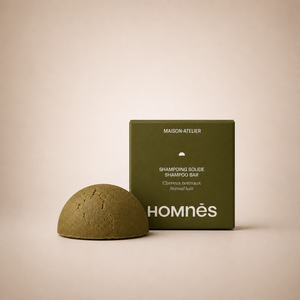
And do not forget the basics: a suitable shampoo. For dry hair, our nourishing solid shampoo with shea, coconut and glycerin, followed by our solid conditioner on the lengths. To go further, read Which shampoo for dry hair? and How to choose the right brush or comb. Not sure what your scalp type is? Take our hair diagnosis.
In short
- Oil bath: choose a penetrating oil (coconut, olive, avocado, almond, castor) and do not leave it on for days.
- To coat and smooth: a non-penetrating oil (jojoba, sunflower), without overdoing it.
- Never put oil on your roots, especially if your scalp is oily.
- Ayurvedic powders are used as masks, depending on your need: purifying, repairing or supporting growth.