
Plastic pollution in cosmetics
Plastic pollution in cosmetics starts in our bathrooms: every year in France, around 175 million bottles of shower gel, shampoo and conditioner are produced and used. Many of these bottles will never be recycled. Here is why, how to sort your shampoo bottle properly, and how to cut this waste at the source.
Are shampoo bottles recycled?
France has set itself an ambitious goal: to recycle 100% of plastic. Yet the recycling rate barely reached 26% in 2022. The rest is incinerated or buried in landfill.
In addition, every year France exports millions of tonnes of waste to emerging countries where traceability can be uncertain. In 2020, for example, of the 12 million tonnes of waste exported by France according to customs data, 800,000 tonnes were plastic waste.
Can plastic be recycled indefinitely?
Contrary to popular belief, plastic cannot be recycled indefinitely: it degrades with each new cycle. Recycling is still useful, but it is not enough to solve the problem of plastic waste.
What are the consequences of plastic pollution?
Worldwide, it is estimated that 32% of the plastic produced will end up in nature, particularly in the oceans.
- For marine life: swallowing debris harms and poisons animals, particularly sea turtles and seabirds, but also marine mammals and fish. These animals usually swallow debris they mistake for prey.
- For human health: according to the World Health Organization, the spread of plastic in nature can lead to some of its components entering the human food chain.
Where should you throw away a shampoo bottle?
In France, all plastic packaging, including shampoo and shower gel bottles, goes in the recycling bin (usually yellow). A few simple steps help recycling:
- empty the bottle completely; there is no need to rinse it;
- leave the cap screwed on;
- do not nest it inside other packaging.
A bottle that is still full should not go in the recycling bin: finish it or give it away. Rules can vary, so check those of your local area.
How to reduce plastic waste in the bathroom
Faced with this problem, the only viable solution is to avoid producing and using plastic packaging. In the bathroom, that starts with everyday care products:
- replace liquid shampoo with a solid shampoo;
- replace shower gel with a solid soap, such as our silk soaps;
- choose a solid conditioner rather than a bottle.
A solid care product lasts longer if it dries well between uses: a magnetic soap holder fixed to the shower wall keeps it dry. To get started, also read the benefits of solid shampoo.
The Homnès Maison-Atelier's commitment
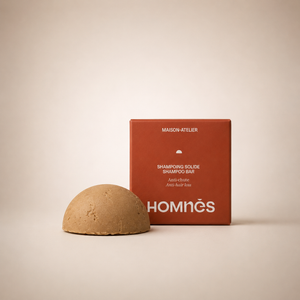
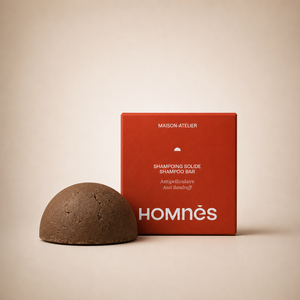
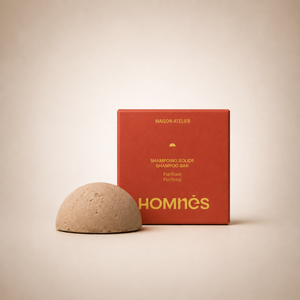
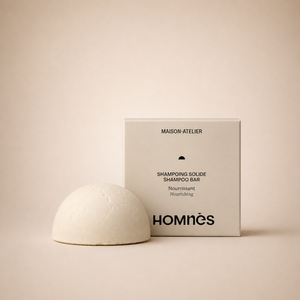
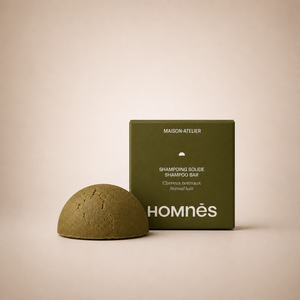
With this in mind, Homnès set out to offer a solid shampoo that performs as well as a professional-quality bottled shampoo, without using plastic.
We are determined to support the ecological transition without compromising on quality. Today, the Homnès Maison-Atelier offers a shampoo with no plastic packaging. Tomorrow, it is committed to keeping the same quality while favouring locally produced ingredients.
In short
- Around 175 million bottles of shower gel, shampoo and conditioner are used every year in France.
- The plastic recycling rate was 26% in 2022, and plastic degrades every time it is recycled.
- An empty bottle goes in the recycling bin with its cap on.
- The surest way to reduce this waste is to switch to solid care products.
Sources: